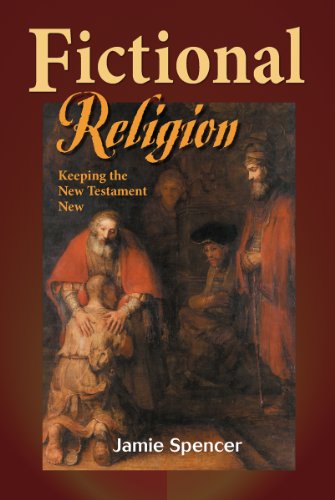
The books of the New Testament are not the infallible words of God. The texts were in a state of flux during the faith’s early centuries. We can and should build on that flexible tradition. These are the claims by which this book is guided. In Fictional Religion, Jamie Spencer challenges readers to take a more rational, more scholarly, and a more historical-critical approach to the New Testament. He examines twelve writers who, he posits, allow us to see how thoughtful artists over the last 600 years have taken the Christian doctrine they inherited, and applied both its formal tenets and its spirit to the intellectual needs, social contexts and cultural biases of their age. Throughout the Christian era, playwrights, poets and story writers like Chaucer, Shakespeare and C. S. Lewis have performed the same services for New Testament doctrine that Hebrew Bible prophets and story-tellers provided for Jewish law as laid down in the Pentateuch. Although our creative artists are not allowed official entry into Holy Writ, they shape Christian doctrine and insights in new ways to meet new human conditions. They keep the New Testament new.
“Spencer’s learned and accessible exploration shows the prose and poetry of these English authors to be a source of insight and inspiration.” — Cynthia Briggs Kittredge, Professor of New Testament, Seminary of the Southwest
“A marvelous mash up of sacred and secular texts. The conversation ranges from raucous to sublime, from hilarious to heady. After reading this book, you won t think of God, humans, or books in the same way again.” — Deborah Krause, Academic Dean and Professor of New Testament, Eden Theological Seminary
“A thoughtful, intentionally provocative and helpful work which will challenge experienced theologians and prove equally engaging to a wider audience.” — The Reverend James H. Purdy, Rector, Saint Peter s Episcopal Church, Ladue, St. Louis, Missouri
“Surprising and pleasing. Any open-minded reader of this irenic book is likely to find both instruction and delight. As for the closed-minded ones, there s just the outside chance that it might pry open an eyelid.” — John V. Fleming, Louis W. Fairchild Professor of English and Comparative Literature emeritus at Princeton University
Material taken from the Polebridge Press.
I always appreciate it when an author makes clear at the very beginning what he/she want us to get from their book. Spencer does this in his very first two paragraphs. He states that he is confident that most “sensible thinkers” will concur with the first of his three interconnected claims. I suspect he may be right because conservative readers may put his work aside after reading the first two paragraphs. In his second paragraph he states, “…the books of the New Testament are not the infallible Word of God. No, they are rather the inspired words of devout and humble writers, caught up in the fervor of a radically new understanding of the faith they inherited.”
For many Christians today, some two thousand years later, there is a deeply rooted belief that in literature, as in many other areas of life, there is the “sacred” and there is the “profane”; now more often referred to as the “secular”. In his new book, Fictional Religion, Jamie Spencer sets out to blur or even erase the line between the two. He has the mission to take a “more rational, more scholarly, and more historical-critical approach to what many ages have agreed to consider sacred, possibly even written in stone.”
Spencer also wants us to understand that the early texts were not fixed, but were in a state of flux during the early centuries.
His third and most extravagant proposition is that we “can and should build on that flexible tradition, turning to other, later stories penned over many centuries by creative artists.”
Spencer had a career teaching English literature to high school girls at Mary Institute and has since retirement been teaching at Washington Lifelong Learning adult education program in the St. Louis area. He has long been a regular scripture reader at Episcopal churches.
In the Introduction under the title, “Sacred or Profane? Does It Matter?” he makes clear that the distinction of whether a writing made it into the Canon, or, like the Gospel of Thomas, “Q”, and other important literature, did not, is not a distinction that is truly significant. In this regard, he points out that the story of woman taken in adultery most likely did not make it into the Gospel of John until some years later.
He reminds us that the “canonization” process was carried out by normal imperfect human beings who used their best judgments, but were not inspired by some divine oracle. The very concept of a “canon” was a product of the culture in that period of time.
By offering us examples from writings from as early as Chaucer, then on to Shakespeare, George Herbert, John Donne, Andrew Marvell, Tennyson, William Golding and John Milton, G.B. Shaw, Faulkner, Philip Larkin and C. S. Lewis, he reveals to us to literature that is filled with religious truth, dealing with much of the same themes we find in both our Old and New Testaments.
Spencer is clear and direct in his statement: “Literary creators and their creations, from those of Chaucer to those of C .S. Lewis are every bit as inspired and inspirational as the canonical texts of the Bible.”
Common to both our “Sacred” and our “Profane” literature is that much of what is presented is in story and parable form, which makes it much more accessible and powerful to the listener and the reader. A recent example of this is the popular series of stories set in “Narnia”, by C.S. Lewis, which would have never become popular in lecture form. The Harry Potter series also contains numerous stories of how Good and Bad are choices facing all of us all the time.
The blurring of “Sacred” and “Secular” is illustrated by the fact that many Christians are not even aware that the story of Satan being cast from Heaven and coming down to earth to lead Adam and Eve astray comes from Milton’s “Paradise Lost” and not from the Bible. “Satan” as a “Being” is not found in the Bible.
A theme so universal and fundamental that it is found world-wide and through the centuries is that of “Death”. In Genesis and other writings we find the idea that death was not built into the structure of all creation, but resulted from “flaws” occurring that brought about the breakdown of the original perfection that included eternal life for all things.
Two questions arise from this concept: one being “Why” did death occur, and the second, almost synonymous is “How did death first originate?” Missing from both the canonical writings and from the later religiously inspirational literature is the more modern concept, acceptable to some, but not to many, that “Death” is not a foreign interloper that slipped into the created universe, but is instead, like “creation” and “life” inherent in all that exists.
We are seeing this concept growing with our increased awareness that both “creation”, from the moment of the “Big Bang”, and “Destruction”, or “Death” occur constantly not only on our planet, Earth, but on stars and galaxies, and that what we call “Death” is also simply a transformation into new forms of existence.
I, of course, have no way of knowing, but perhaps John Milton would have had a less negative view of the human condition if he had imagined “Death” more in the light of “transformation” rather than the end of it all. But I also tend to believe that our feelings about “Death” in general and most specifically our own approaching event are not primarily based on our rational thought and are therefore not readily altered by rational discussion.
I found Spencer’s book both very interesting and also a welcome support for my growing experience of the wonderfully interconnected wholeness of all things. It is one more piece in my perception of the universe as totally saturated with the “divine spirit” which is often called “God”.