Distinguishing between religion and spirituality, Burke offers what he calls a new way of looking at God, one centered on the idea of grace. He emphasizes a God who is looking to save the world, not a God who seems more intent on condemning certain practices . . . . For Burke, God is to be questioned, not simply obeyed. His challenging thesis will appeal to many people today who have given up on organized religion but still seek some connection to spirituality.
“It’s easy for inquisition-launchers to go on fault-finding missions; they have lots of practice and they’re really good at it. What’s more challenging, and regarding this book, much more worthwhile, is to instead go on a truth-finding mission. And yes, even in a book with ‘heretic’ in the title, I believe any honest reader can find much truth worth seeking.” -From the Foreword by Brian D. McLaren
“Some Christians have the ability to make you want to be a Christian just by being who they are. They make the gospel alive, real, healing, and utterly attractive. I think Spencer Burke is just one of those people. In his writings he shares himself and his vision” -Fr. Richard Rohr, Center for Action and Contemplation, Albuquerque, New Mexico
“If Spencer Burke is a heretic, it’s not because he’s teaching dangerous doctrine, but because he asks the questions about faith that today’s sensibilities naturally raise. Spencer is a winsome walking companion for those who find traditional dogma too narrow. It’s a thoughtful conversation.” -Marshall Shelley, editor, Leadership Journal; vice president, Christianity Today
Heretics Guide to Eternity Spencer Burke by Barry Taylor, Jossy Bass, A Wiley Imprint, 2006 San Francisco, CA
In the last few decades we have seen quite a large number of books written on issues dealing with the enlarged perception of the role of Jesus both in history and in his role as the central figure of the Christian faith. It has become increasingly clear that he has been and still is viewed in different and even conflicting ways as New Testament scholars uncover a variety of new documents from the first three centuries that were written by both known and unknown writers.
Along with the growing number of relevant documents is the fact that the “scientific method” has led to a significantly different method of Biblical scholarship, so that all materials and “truth” must now be subjected to the question; “what does the evidence indicate?” Therefore such seemingly eternal and unalterable “truths” as; “Jesus is/was God’s only Son” who reigns with him through eternity” now meet the response “what does the evidence indicate?”
One response to this modern approach is the re-examination and alteration of the role of not only the structure of the church, but even of institutional religion in our modern world. Is “religion,” as we have known it through the centuries, still a meaningful foundation stone of our modern culture?
Some scholars are led to this question after concluding that Jesus was indeed fully human, one who is no longer a member of a theological Trinity, but the authors Spencer Burke and Barry Taylor never even address the question of a “proper” or “modern” Christology. Instead, as they write on page eleven, “Do I remain personally committed to Jesus and his teachings as found in the Bible? I do.”However they clarify what might appear to be a contradiction on page 61; “This is the real scandal of Jesus. His message eradicated the need for religion. It may come as a surprise, but Jesus has never been in the religion business. He’s in the business of grace, and grace tells us there is nothing we need to do to find relationship with the divine. The relationship is already there; we only need to nurture it.”
This is the central and ongoing idea throughout the book. Bono of U2 fame is quoted in a short sentence that captures their main point; “I don’t see Jesus Christ as being in any part of religion. Religion is the Temple after God has left it.”
“Nowhere does Jesus call his followers to start a religion. Jesus’ invitation to his first disciples was to follow him.” And this is what the entire book is about.
A core of this is the rejection of the belief in the inherent sinfulness of humankind, calling for the suffering and death on the cross of God’s Son, Jesus. Instead, the authors believe humankind is loved by God from conception and never needs saving from the wrath that would send them to hell. Instead, the real journey of the spiritual traveler is to continually move toward the understanding and experience of that surrounding and saturating Grace that has always been present, though we are often unaware of its existence.
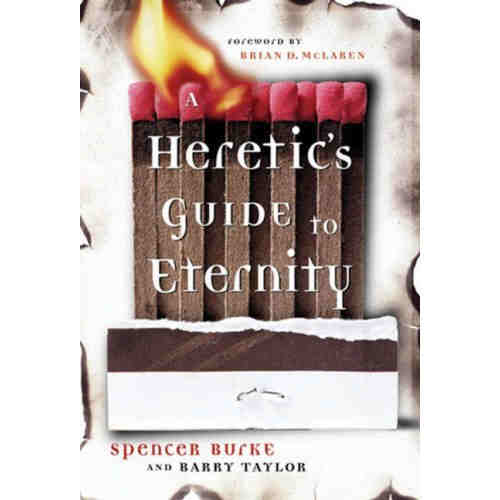
The layout of the book is one that makes it an easy and pleasant read. That’s a real plus if we have been plowing through some of the many books with small fonts and scrunched up lines and paragraphs. Numerous pages have insert blocks (…is that the best term? Choose a better one if you have one) that contain salient ideas from the section. These are framed in the “burned edges” frame that is used on the book cover and make for a more “friendly” appearance.
The “audience” that will most appreciate this book are those who are open to a broader and more compassionate view of what the spiritual life can become. If they really “get it”, they will experience a sense of freedom from the traditional guilt oriented, finger-pointing and fear based religious faith they have known and experienced.
The religious scholar may feel dissatisfied with the lack of attention paid to the newly revealed and more complex picture of Jesus as presented by such as the Jesus seminar and other foremost Jesus researchers. But the book will be very helpful to anyone who is questioning their understanding of the Christian faith or searching for a new approach but “do not want to throw out the baby with the bath water.” After all it is written by two highly educated and informed men who have come a long way in their own respective journeys.
Evangelicals: The New Universalists
Well, not all of them of course. And certainly not your more fundamentalist types, but people like Spencer Burke and Barry Taylor, authors of A Heretic’s Guide to Eternity which I picked up after it was mentioned on the website and newsletter at Micah’s Porch, you betcha.
How could I not love this book, being a UU, one who revels in heresy, being my base theology is deemed heretical by orthodox and mainline Christianity by definition? A definition of which I am proud and they, of course, are not – I refuse to give up the right to choose what I will believe and practice as the spiritual life.
The love of God is an opt-out proposition, not an opt-in for those who meet the membership rules. Well, no kidding you say, but this is coming from not from your standard liberal theologian from Evangelicals. There is a major shift going on in a theological community generally assumed to be the polar opposite of Unitarian Universalism. How it impacts us is something we should pay attention to because the religious communities it creates may, or may have already become our competition.
Burke and Taylor quote Nick Cave:
Everybody got a room In God’s Hotel. Everybody got a room. Well you’ll never see a sign hanging on the door Sayin ‘No vacancies anymore’
Later on they sound, well Ballou-ish, and then get to this:
…many people’s theology is almost obsessed with our afterlife destination. Christianity is all about getting saved from sin and saved from hell, the punishment for sin. But this is a distortion, or at least a reduction of the Bible’s notion of salvation. The idea of salvation in the Bible encompasses many ideas, including things like bondage and liberation, separation and reconciliation. At it’s most basic, salvation means healing (author’s emphasis in the original – pg 180).”
Again, this hardly sound revolutionary. Were this coming from a Unitarian Universalist, you might even say, yeah, what’s the big deal?” But this is coming from people fed up with the standard quo within Evangelical Christianity and what they want instead sounds very familiar doesn’t it, UUs?
Aren’t these people sounding very ripe for invitation to UU congregations? Keeping in mind, of course, that their religious imagination and spirituality is still Christian. But keeping in mind that they are troubled also by the institution of churches in general. And that’s where the rubber hits the road because we can’t claim our congregations are, across the board, bursting at the seams. On that point we actually share the problems of the “orthodox” Christian communities Burke and Taylor write about.
“For years,” they write we have assumed organized religion is the only ways humanity can have a relationship with the divine other…but today, many people are beginning to realize that faith can exist outside the realm of organized religion. The only problem is that religious people don’t understand this option – nor do they want to. They feel threatened by the shift to spirituality, and they’re quick to point its dangers rather than see its potential. Still, in spite of their best efforts, interest in spirituality is flourishing (53).”
One is tempted to say, once again, well if people are looking for spirituality instead of religion, come on over to a UU church. But is that really the case? How many of our congregations are still wedded to organ music…to hierarchical governance structures, if not hierarchy? How many are places where things labeled new age are dismissed out of hand?
Burke and Taylor make an interesting analogy that bears examining for those interested in issues of congregational growth and vitality. They say that the church (any church, not just Evangelical, it could be mainline, Catholic, etc) is like a post office in an email world. Think about it. Before email and the Internet:
There was a time when the post office was absolute essential. It was a center of society. If you wanted to send a message to someone or pay a bill, you needed a middleman – a letter carrier, to do so. In the same way, the institutional church has long been the middleman between God and society…The world is a different place today. I am in no way saying the post office is obsolete. We still depend on it for many things, but increasingly its role in our lives is being eclipsed by other means of information delivery…
The challenge for people of faith who seek to move forward is to acknowledge these shifts in culture and recognize that the institutional church must now find its own way. The things people used to come to the one-hour event on Sunday morning for are not the drawing cards they once were. Today it seems we respond directly to the mystery of the message that religion was created to decipher.
The institutional church can dismiss this as a byproduct of a consumer culture and insist that we need to get back to basic. That could miss the point that the basics for a whole new generation have changed (133-135).
Indeed and it could go a long way towards explaining why, even though our Unitarian Universalist theology and world view seems to meet the questing needs of so many spiritual seekers that our congregations still aren’t growing.
Reverend Tony Lorenzen
http://www.sunflowerchalice.com