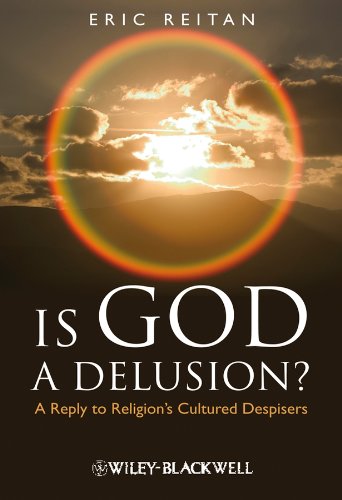
“Is God a Delusion?” addresses the philosophical underpinnings of the recent proliferation of popular books attacking religious beliefs. Focuses primarily on charges leveled by recent critics that belief in God is irrational and that its nature ferments violence Balances philosophical rigor and scholarly care with an engaging, accessible style Offers a direct response to the crop of recent anti-religion bestsellers currently generating considerable public discussion.
Atheism-and contra-atheism-is a much overpublished topic, and Reitan, a professor of philosophy at Oklahoma State University, is late to the party. Nonetheless, he makes an elegantly argued response to Christopher Hitchens et al. that is refreshing in several respects. Neither polemical nor defensive, he writes primarily as a logician, rather than a believer. He brings into the contemporary fray many philosophers who reasoned well about God long ago: Anselm, Aquinas, Leibniz, Schleiermacher. He explains so many arguments so clearly that the book could function as an introductory philosophical text on the perennial subject of God’s existence. He also looks squarely in the face of the contemporary horrors that many have used to argue for God’s non-existence and still comes off the theodicy battleground with a sense of God as ethico-religious hope, “the substance of things hoped for.” The clarity of his presentation should make this book useful after atheism has finished its moment in the sun.
Reitan’s book is filled with many deep and complex ideas. It is not to be picked up for brief and casual reading episodes, but it is rewarding for those willing to do the careful and serious thinking that is called for. While I found it difficult to write a review of the book, I also found it compelling me to go back and re-read section after section because he presents so many thoughts that are well worth the careful thinking required.
So often in books dealing with the “God versus No God“ debate the writers use the word in a very imprecise way, seemingly unaware of the critical role of language, especially when dealing with such slippery and amorphous matters. It is a pleasure to find in Eric Reitan’s book a clear understanding of the problem.
Reitan’s response is most especially to Richard Dawkins and his book The God Delusion (2006) but he also addresses Sam Harris and his The End of Faith (2004) and other atheists. While Reitan is only one of many who have entered the fray between the “no God” and the “God” believers, his writing deserves our attention because he has a deeper knowledge of the subject than many others, some of whom he accuses of “careless thinking and intellectual laziness” which “are masked behind bluster and bravado.. Dawkins mangling of Aquinas is a perfect example of this wretched trend.”
As he read Dawkins’ book he says; “I was taken in by the author’s swagger. Dawkins is clearly confident, writing as if he knows what he’s talking about. The only problem is that, as often as not, he has no idea what he’s talking about.” When he comments on Dawkins’ refutation of Aquinas he states; “No important objections, successful or not, come from Dawkins. Instead he offers a cavalier attack on a caricature, in which swagger replaces careful thinking.”
Reitan agrees that some religious thinkers and writers use faulty logic to support their God hypothesis and challenges them to become more careful and rigorous thinkers. But he also points out the similar kinds of errors of thought that he finds in the atheists as they challenge the faulty logic of believers. While he is responding primarily to Dawkins’ work, he considers his writing as considerably below the quality of other atheists such as Mackie, Martin, and most especially William Rowe, whom Reitan considers the most thoughtful and meticulous atheist philosopher.
Reitan states that he was inspired by the writings of the young theologian, Friedrich Sshleiermacher, who wrote over two hundred years ago in response to a similar rash of attacks on religion by the intellectual elites recently inspired by the Enlightenment. He considers Schleiermacher the father of modern theology.
He makes clear that he is not defending biblical inerrancy, considering it both wrong and dangerous, nor is he defending the doctrine of hell, considering it mistaken and dangerous, at least in its most traditional formulation, nor does he defend “faith” understood as stubborn belief without regard to evidence.
Reitan sums up Dawkins arguments with the following: “He thinks that for an intelligent creator of the universe to explain the enormously complex universe we live in, that creator would need to be enormously complex too. And so, when we explain the universe in terms of the creative efforts of a God, we have only shifted what needs to be explained one level.” In Dawkins’ terms, any God capable of designing a universe, carefully and foresightfully tuned to lead to our evolution, must be a supremely complex and improbably entity who needs an even bigger explanation than the one he is supposed to provide, (p. 147).”
As he moves toward dealing with the God question on the more personal level he writes of Simone Weil, who greatly influenced and inspired him. Born in France of secular Jewish parents, she was a passionate fighter for those she considered the downtrodden, in one period fighting in Spain against Francisco Franco with the communists. Through a very powerful mystical experience she comes to feel filled with the Christ spirit and “writes some of the most potent mystical reflections on the Christian God ever recorded”
She cautions us about the “gods of imagination”, believing that in the grip of such images we make it impossible for the true God to enter. Thus, she believes atheism can be a kind of spiritual “purification”. She saw her religious experience and her devotion to her God as entirely compatible with atheism, in a certain sense.
Reitan follows this path of dealing with the “God – no-God” issue by bringing his own personal faith into the discussion. Moving from theistic, cosmic, philosophical or scientific approaches, he brings in what he calls the Lutheran approach to God. In this mode, God is that being who “saves us” from sin. The main point is that this comes from nothing that humans can do for themselves. He goes on to say that the very act of trying to determine the truths about God, because is stems from our own efforts, may well prevent God being revealed to us. God will be revealed to us only by his own efforts, and this comes from our experiencing the reality of Love. When we experience both loving someone and being loved by someone, we are experiencing the most perfect revelation of God.
Reitan states his belief that no institutions, churches, religions or any other would be God’s choice to most fully reveal himself, but does so instead through the person to person contacts of everyday life. He concludes by making clear that he makes no claim to having found “the truth” about God, but that he is comfortable with his religion of hope and trust. He goes on to say that we may well find in some of the religious communities people with whom we can develop relationships rich in compassion and love.
I wish to close the review with a postscript containing a challenge to those who write of the “God vs. No-God” issue: I find it very interesting that the debate is generally carried out within a massive vacuum, the almost total absence of a cosmological framework. It is not surprising that most of us humans perceive the world from our “human-centric” viewpoint. We are “It”. The universe is about Us. Nevertheless, our knowledge of the larger cosmos has progressed to the point that I would expect those who are educated and spend great amounts of time thinking and writing about something as all-inclusive as “God” would seriously consider what we have learned about the universe to give it a central place in their thinking about “Him”.
Consider, for example, that humans have existed on this planet only a tiny fraction of the existence of our planet, and that the universe itself existed long before our planet came into being. Still in looking at the question of “God” most think of “Him” only in relation to we humans.
The question of “Evil” is generally perceived entirely in relation to human existence. I’ve never read of anyone writing about the problem of Evil as existing in the world prior to the appearance of humans. In the “natural world” life and death are seen as inseparable parts of the life process. No one has written of the evil process of larger fish feeding on smaller fish, or of larger insects feeding on smaller ones. It is only when humans are involved that we bring in the new element we call “Evil”.
And I’ve never yet come across written material dealing with the theological implications of the fact that there are almost assuredly many millions of life supporting planets scattered among the billions of galaxies and that in the life of the universe not only are these and the non-life supporting planets destroyed, but the even the entire galaxies in which they exist also destroyed in mega-gigantic collisions with other galaxies. Apparently the entire universe takes part in a continual “creation – destruction” process.
We are prone to want to think of a Creator God who “cares” about us humans Does this God “care” about particular life forms on the millions of life supporting planets when “He” apparently readily destroys not only their home planets, but the solar systems and even the galaxies in which they reside. In that context, what does the word “care” mean?
Are we to exclude this level of thinking when we look at the “God” vs. ‘No God” issue? If so, then let’s admit that our human “brain-mind” is not yet up to the task of arriving at definitive answers or explanations. Humility is always a good starting point.
Reitan’s book is filled with many deep and complex ideas. It is not to be picked up for brief and casual reading episodes, but it is rewarding for those willing to do the careful and serious thinking that is called for. While I found it difficult to write a review of the book, I also found it compelling me to go back and re-read section after section because he presents so many thoughts that are well worth the careful thinking required.So often in books dealing with the “God versus No God“ debate the writers use the word in a very imprecise way, seemingly unaware of the critical role of language, especially when dealing with such slippery and amorphous matters. It is a pleasure to find in Eric Reitan’s book a clear understanding of the problem.Reitan’s response is most especially to Richard Dawkins and his book The God Delusion (2006) but he also addresses Sam Harris and his The End of Faith (2004) and other atheists. While Reitan is only one of many who have entered the fray between the “no God” and the “God” believers, his writing deserves our attention because he has a deeper knowledge of the subject than many others, some of whom he accuses of “careless thinking and intellectual laziness” which “are masked behind bluster and bravado.. Dawkins mangling of Aquinas is a perfect example of this wretched trend.” As he read Dawkins’ book he says; “I was taken in by the author’s swagger. Dawkins is clearly confident, writing as if he knows what he’s talking about. The only problem is that, as often as not, he has no idea what he’s talking about.” When he comments on Dawkins’ refutation of Aquinas he states; “No important objections, successful or not, come from Dawkins. Instead he offers a cavalier attack on a caricature, in which swagger replaces careful thinking.” Reitan agrees that some religious thinkers and writers use faulty logic to support their God hypothesis and challenges them to become more careful and rigorous thinkers. But he also points out the similar kinds of errors of thought that he finds in the atheists as they challenge the faulty logic of believers. While he is responding primarily to Dawkins’ work, he considers his writing as considerably below the quality of other atheists such as Mackie, Martin, and most especially William Rowe, whom Reitan considers the most thoughtful and meticulous atheist philosopher.Reitan states that he was inspired by the writings of the young theologian, Friedrich Sshleiermacher, who wrote over two hundred years ago in response to a similar rash of attacks on religion by the intellectual elites recently inspired by the Enlightenment. He considers Schleiermacher the father of modern theology.He makes clear that he is not defending biblical inerrancy, considering it both wrong and dangerous, nor is he defending the doctrine of hell, considering it mistaken and dangerous, at least in its most traditional formulation, nor does he defend “faith” understood as stubborn belief without regard to evidence.Reitan sums up Dawkins arguments with the following: “He thinks that for an intelligent creator of the universe to explain the enormously complex universe we live in, that creator would need to be enormously complex too. And so, when we explain the universe in terms of the creative efforts of a God, we have only shifted what needs to be explained one level.” In Dawkins’ terms, any God capable of designing a universe, carefully and foresightfully tuned to lead to our evolution, must be a supremely complex and improbably entity who needs an even bigger explanation than the one he is supposed to provide, (p. 147).”As he moves toward dealing with the God question on the more personal level he writes of Simone Weil, who greatly influenced and inspired him. Born in France of secular Jewish parents, she was a passionate fighter for those she considered the downtrodden, in one period fighting in Spain against Francisco Franco with the communists. Through a very powerful mystical experience she comes to feel filled with the Christ spirit and “writes some of the most potent mystical reflections on the Christian God ever recorded”She cautions us about the “gods of imagination”, believing that in the grip of such images we make it impossible for the true God to enter. Thus, she believes atheism can be a kind of spiritual “purification”. She saw her religious experience and her devotion to her God as entirely compatible with atheism, in a certain sense.Reitan follows this path of dealing with the “God – no-God” issue by bringing his own personal faith into the discussion. Moving from theistic, cosmic, philosophical or scientific approaches, he brings in what he calls the Lutheran approach to God. In this mode, God is that being who “saves us” from sin. The main point is that this comes from nothing that humans can do for themselves. He goes on to say that the very act of trying to determine the truths about God, because is stems from our own efforts, may well prevent God being revealed to us. God will be revealed to us only by his own efforts, and this comes from our experiencing the reality of Love. When we experience both loving someone and being loved by someone, we are experiencing the most perfect revelation of God.Reitan states his belief that no institutions, churches, religions or any other would be God’s choice to most fully reveal himself, but does so instead through the person to person contacts of everyday life. He concludes by making clear that he makes no claim to having found “the truth” about God, but that he is comfortable with his religion of hope and trust. He goes on to say that we may well find in some of the religious communities people with whom we can develop relationships rich in compassion and love.I wish to close the review with a postscript containing a challenge to those who write of the “God vs. No-God” issue: I find it very interesting that the debate is generally carried out within a massive vacuum, the almost total absence of a cosmological framework. It is not surprising that most of us humans perceive the world from our “human-centric” viewpoint. We are “It”. The universe is about Us. Nevertheless, our knowledge of the larger cosmos has progressed to the point that I would expect those who are educated and spend great amounts of time thinking and writing about something as all-inclusive as “God” would seriously consider what we have learned about the universe to give it a central place in their thinking about “Him”. Consider, for example, that humans have existed on this planet only a tiny fraction of the existence of our planet, and that the universe itself existed long before our planet came into being. Still in looking at the question of “God” most think of “Him” only in relation to we humans. The question of “Evil” is generally perceived entirely in relation to human existence. I’ve never read of anyone writing about the problem of Evil as existing in the world prior to the appearance of humans. In the “natural world” life and death are seen as inseparable parts of the life process. No one has written of the evil process of larger fish feeding on smaller fish, or of larger insects feeding on smaller ones. It is only when humans are involved that we bring in the new element we call “Evil”. And I’ve never yet come across written material dealing with the theological implications of the fact that there are almost assuredly many millions of life supporting planets scattered among the billions of galaxies and that in the life of the universe not only are these and the non-life supporting planets destroyed, but the even the entire galaxies in which they exist also destroyed in mega-gigantic collisions with other galaxies. Apparently the entire universe takes part in a continual “creation – destruction” process. We are prone to want to think of a Creator God who “cares” about us humans Does this God “care” about particular life forms on the millions of life supporting planets when “He” apparently readily destroys not only their home planets, but the solar systems and even the galaxies in which they reside. In that context, what does the word “care” mean?Are we to exclude this level of thinking when we look at the “God” vs. ‘No God” issue? If so, then let’s admit that our human “brain-mind” is not yet up to the task of arriving at definitive answers or explanations. Humility is always a good starting point.