In the Hellenistic world, writings were read aloud, heard and remembered. But
modern exegesis assumes a silent text. The disjuncture between ancient and modern approaches to literature, argue Margaret Lee and Brandon Scott, obscures the beauty and meaning in writings such as the New Testament. Through a close analysis of writings from the four gospels, Paul, and Q, they advance a theory of sound analysis that will enable modern readers to hear the New Testament afresh.
“A fundamental breakthrough for biblical studies. . . . It will revolutionize the way scholars analyze and interpret texts.”
—Arthur J. Dewey, Xavier University
Sound Mapping the New Testament
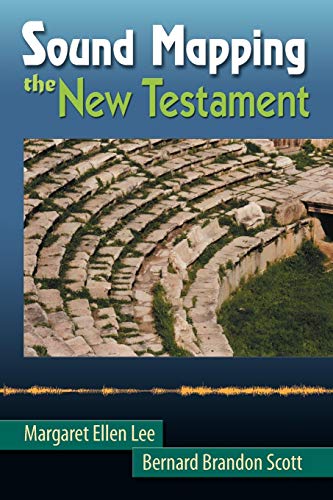
Margaret Ellen Lee & Bernard Brandon Scott
Polebridge Press, Salem Oregon, 2009
After almost eight decades of reading the New Testament, it appeared I was about to encounter a brand new pathway to experiencing this document that has been so significant in my life. Though Christians are used to hearing the scriptures read aloud, we are still more familiar with silently reading them. And though most of us have become comfortable with the fact that we are reading translations from the original documents, we have assumed little, if any, has been lost in the translations.
Authors Lee and Scott now present us with an idea that is truly a breakthrough in New Testament studies. I find their book, however, both a “Project of impressive intellectual profundity and audacity, (from the back cover), but also a frustrating disappointment.
First, the positive side: Their primary thesis is one that should be widely known and appreciated by all within the Christian Faith. That is that when the events that created the NT were happening, speech, not writing, was the primary means of communication. The authors offer a wealth of material that clarifies how very primitive in both materials and technique was writing in that period. That section alone made me appreciate having come across the book. It helped me have a much wider and clearer picture of the culture then in existence. I had not understood, for instance that the scribes who copied material onto the wax tablets or papyrus scrolls often did not know what it was they were writing. Nor did I know that the authors of the manuscripts were often not able to write down what they had composed.
One fact which all bible scholars learned early in their training in Greek, but which few of us laymen knew, was that the written manuscripts have no space between words and no punctuation. That fact alone allows some room for different readings of a given piece of writing.
The authors then present ample resources to help us understand and appreciate the role of public speech in that time. Even most of what was written was for the purpose of oral delivery to groups of listeners. One thing the authors offer us is that public speech had much in common with music in terms of rhythm, cadence, phrasing and sound sequence and structure. Because both the speaker and the hearers would be using memory, in speech as in music, the content is more readily memorized when it has fairly short, rhythmical phrases that repeat certain words and sounds.
The few experts in the field who are scholars both in the original languages and also in the role of the sound of the spoken languages are able to discern the numerous times when the written documents have words, phrases, and sections that are dissonant to other portions of the manuscripts, which likely indicating a different source.
I am grateful to the authors for increasing my knowledge and appreciation of the world at the beginning of our faith.
And now, the frustrating and disappointing part. The simple fact is that the book is not written for, nor suitable for, laypersons such as me. The authors explain the problem in their conclusion.
In one of their concluding sections titled “SOUNDS ARE MEANT TO BE HEARD”, they state; those who would practice sound analysis must adopt a fairly labor-intensive discipline of close reading and analysis, even down to the level of syllable, to compensate for the disadvantage of not actually hearing a composition’s sounds. We can learn to hear a composition, but we can never achieve anything like native listening skill in a language now dead.
They go on to state: A second major consideration in attending to the sounds of a New Testament composition is that it must be read in Greek. Greek words, phrases and sentences are present literally thousand of times throughout the book. This makes it quite clear from the first chapter this is a book to be read by one who is fluent in Greek, as well as English.
They conclude by stating their overall purpose for their diligent and exhaustive work: Sound analysis can neither supplant nor replace other critical approaches to the New Testament, nor would such an outcome be desirable. Rather, sound analysis provides the interpretive endeavor with an additional tool: an analytical process that serves as a basis for other critical approaches. The foundational character of sound analysis means that it does not replace other methods, but rather should become the first ste,p and direct other methods.
I am glad I took the time to read the book, but I predict it will have a small audience outside the field of advanced New Testament scholarship.