This is NOT just another book about the gospels! With a perfect blend of historical context mixed with contemporary insights, Dr. Shaia opens up the gospels in a whole new way. If you are the kind of person who is interested in opening yourself up to a deeper relationship with the Divine, treat yourself to this book.
Dr. Shaia presents a central question for each gospel based on the four communities that struggled with the Living Jesus in their midst. Four historical periods. Four communities with different concerns. Four applicable struggles for our lives today. Four paths, four seasons, a cycle of spirituality and faith.
Combining scholarly research, psychological insights and a lifetime of spiritual inquiry, Shaia has unraveled the historical contexts of the gospels, their different audiences and the big life questions that each addresses. Not just a fresh look but a revolutionary one whether one be clergy or laypersons. Contrasting the historical Jesus with Jesus the Christ and Holy God brings Shaia’s message right into each of our lives, deeply and permanently. How we are finally transformed by our faith after confronting life’s changes, pain and joy is boldly and convincingly told by Shaia.
The Hidden POWER of the Gospels
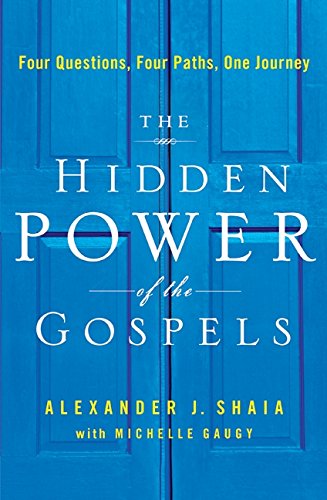
Alexander J. Shaia with Michelle Gaugy
HarperCollins New York , NY 2010
Growing up in a Lebanese Maronite Catholic Family in Alabama subjected the author, Alexander Shaia to the same prejudice experienced by blacks. His grandmother’s home was burned to the ground when he was seven. This experience played a role in his growing dedication to make sure such things never happened again.
His immersion in Middle Eastern culture as a child, instilled in him a deep appreciation of the beautiful poetic words and images from centuries of Arabic history. Later, as a student at Notre Dame he was shocked by the contrast from his previous life.
Later, while in training in seminary for the priesthood Shaia came to feel he could not conform to the narrowness of the profession, but struggled painfully with the knowledge that to choose another direction would bring much upset and criticism by his extended family. He found a path that let him continue in the church, but on a parish staff that allowed him a service that better fit his spiritual aspirations. While enrolled in a doctoral program in psychology, including the influence of a Swiss Jungian analyst who was both a devout Christian and practitioner of Tibetan Buddhist meditation, he repeatedly discovered the four foundational elements of what became his “Quadratos” spiritual journey program.
The authors present their work as a new and comprehensive program, with the book as the introduction to that program. They write boldly: “I believe this new perspective on these ancient, beautiful, and frequently contentious words has been long awaited. It is my belief that this reawakened journey holds the key to unlock what has too long been closed, fearful, and rigid within ourselves and our faith.” They invite us to “come along” on the spiritual journey that will provide a “complete map that stretches across time, place, and culture.” Their term “Quadratos”, comes from the use of four gospels.
Scholars who search through such documents as the Gospel of Thomas or Gnostic texts are dismissed as essentially missing the point. “What we are interested in is human lives filled with meaning and the awareness of greater purpose each and every day—and this requires spiritual transformation. And transformation is a journey which cannot be accomplished by a single gospel. However we are absolutely certain (italics, mine) that in their ancient sequence, the Gospels of Mathew, Mark, John, and Luke—and only these four (italics, theirs)—hold the internal and eternal map of transformation. This is the living treasure of the Christian faith, and it is the only ancient mystery that really matters.”
Encountering the above passages raised the red flags I always experience whenever I come across what appears to be arrogance. While Shaia was put of by the narrowness he saw in the training for the priesthood, his certainty of the superiority of the Quadratos program smacks of the same narrowness. As I read the book, I could well imagine it being a very helpful guide for spiritual growth for many, but I found nothing in it that led me to conclude it is superior to all other such guides for all spiritual seekers.
While there are a number of traits that we humans share, there is at the same time such a vast diversity of personality characteristics, and emotional and spiritual tendencies, that no one has yet found the “one program fits all” solution, nor is that ever likely.
In Quadratos the authors present the gospel of Mathew as focused on the question of “How Do We Face Change?” They see in Mark the focus being on “How Do We Move Through Suffering?” The heading for the chapter on John is “Resting in John’s Glorious Garden ”, with the subtitle “How Do We Receive Joy?” The fourth path, uses the gospel of Luke as the vehicle to address the question: “How Do We Mature in Service?”
The book has pleasant flowing quality to it that must come from the Arabic and Middle Eastern poetic cultural elements. There is an unusual mixture in it of an easy comfort with a broad openness to the world’s faiths, and yet the gospel material is offered with a biblical literalist sound to it.
The author’s commitment to their “new and creative” program has a passion that appears to dismiss whatever doesn’t appear to support it.
My awareness of how such certainty and apparent authority is very attractive to great numbers of seeking people, leads me to surmise that they will find a growing number of “disciples” who will find nourishment and comfort in their program. The book is rich in material that is quick and easy to quote and serve as gems to say to oneself during the days of a busy week.
Reviewer: Dean G. Watt