You can skip to the end and leave a response. Pinging is currently not allowed.
One comment on “The Meaning of Jesus: Two Visions”
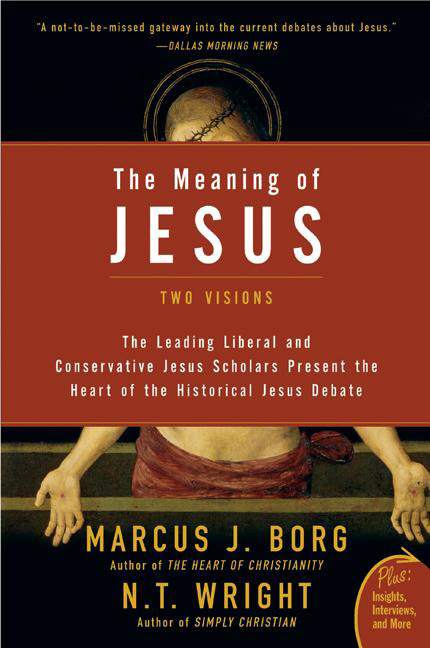
Over the past several decades there has been a renewed ‘quest for the historical Jesus.’ Beginning about 1980 in the world of scholarship, the quest has engaged the interest, not only of Christians, but also the general public to a remarkable extent. Two of the scholars who have written books making the Jesus quest accessible to all are the authors of this book. Marcus J. Borg is Hundere Distinguished Professor of Religion at Oregon State University, author of the best selling Meeting Jesus Again For The First Time. N.T. Wright is Dean of Lichfield Cathedral in England, author of Jesus and The Victory of God. Borg is a member of the Jesus Seminar. Wright has been an outspoken critic of the Seminar. The genesis of this book is a friendship which began in 1984 after Tom Wright had read Marcus Borg’s book Conflict, Holiness, and Politics in the Teachings of Jesus and sought him out to congratulate him, as well as to explore with him some issues raised by the book. (A new edition of the book was published in 1998 by Trinity International Press with a foreword by Wright.) Their friendship grew "out of the fascinated study of Jesus within his historical context" and gave birth, some fourteen years later, to this book "in which we put down some markers indicating where the conversation has led." They state that in their conversation "within the bounds of friendship and shared Christian faith and practice we have both frequently been puzzled, and even disturbed, by some of what the other has said. Working on this book has at least enabled us to understand each other a lot better, to explain to each other (and perhaps to our readers) things that we each have thought were clear but that apparently weren’t, and to remove impressions that had been unwittingly given." It is their hope that the shared work over the years may model a way of conducting Christian disagreements over serious issues.The book consists of eight parts: I How Do We Know About Jesus? II What Did Jesus Do and Teach? III The Death of Jesus, IV "God Raised Jesus From the Dead", V Was Jesus God? VI The Birth of Jesus VII, "He Will Come Again in Glory" and VIII Jesus and The Christian Life. Each part consists of two chapters, one by each author. Most of each chapter summarizes what has been written in their previous works, although at points, partly as a result of their continuing dialogue, they go beyond earlier positions. In each chapter there is some engagement between the authors in which questions are posed, and agreements as well as disagreements marked.Simplistically speaking, Borg might be considered ‘liberal’ and ‘revisionist’, and Wright would be called ‘conservative’ and ‘traditionalist’. The authors say that there is a ‘grain’ of truth in these labels, but they regard them as "quite misleading." Their "two visions" of the meaning of Jesus differ because of many factors, which are noted in the development of their presentations. Generally speaking, one could say that both authors agree that the Gospels contain historical material (history remembered) and interpretative material (history metaphorized). However, they disagree on the scope of each category. Wright sees more of the Jesus of history (the Pre-Easter Jesus) in the Gospels than Borg. Borg sees more of the Christ of faith (the post-Easter Jesus) in the Gospels than Wright. It is Borg’s conviction (I am not sure it is shared by Wright) that both "angles of vision" are valid and useful and therefore "complimentary and not competitive".In the concluding chapter, which describes the images of the Christian life that emerge from their study, there is considerable agreement. Each author gives us his vision of what is involved in being a Christian today.This is an important book. Its unique format provides the reader with an overview of the main issues involved in the quest of the historical Jesus from two perspectives. It is important because it models the dialogue between these perspectives which is necessary if the quest is to bear fruit in the life of the community of the Church.
Join thousands of others like you who are contributing their voice to Progressive Christianity and list your church, organization or yourself in our global directory.
Over the past several decades there has been a renewed ‘quest for the historical Jesus.’ Beginning about 1980 in the world of scholarship, the quest has engaged the interest, not only of Christians, but also the general public to a remarkable extent. Two of the scholars who have written books making the Jesus quest accessible to all are the authors of this book. Marcus J. Borg is Hundere Distinguished Professor of Religion at Oregon State University, author of the best selling Meeting Jesus Again For The First Time. N.T. Wright is Dean of Lichfield Cathedral in England, author of Jesus and The Victory of God. Borg is a member of the Jesus Seminar. Wright has been an outspoken critic of the Seminar. The genesis of this book is a friendship which began in 1984 after Tom Wright had read Marcus Borg’s book Conflict, Holiness, and Politics in the Teachings of Jesus and sought him out to congratulate him, as well as to explore with him some issues raised by the book. (A new edition of the book was published in 1998 by Trinity International Press with a foreword by Wright.) Their friendship grew "out of the fascinated study of Jesus within his historical context" and gave birth, some fourteen years later, to this book "in which we put down some markers indicating where the conversation has led." They state that in their conversation "within the bounds of friendship and shared Christian faith and practice we have both frequently been puzzled, and even disturbed, by some of what the other has said. Working on this book has at least enabled us to understand each other a lot better, to explain to each other (and perhaps to our readers) things that we each have thought were clear but that apparently weren’t, and to remove impressions that had been unwittingly given." It is their hope that the shared work over the years may model a way of conducting Christian disagreements over serious issues.The book consists of eight parts: I How Do We Know About Jesus? II What Did Jesus Do and Teach? III The Death of Jesus, IV "God Raised Jesus From the Dead", V Was Jesus God? VI The Birth of Jesus VII, "He Will Come Again in Glory" and VIII Jesus and The Christian Life. Each part consists of two chapters, one by each author. Most of each chapter summarizes what has been written in their previous works, although at points, partly as a result of their continuing dialogue, they go beyond earlier positions. In each chapter there is some engagement between the authors in which questions are posed, and agreements as well as disagreements marked.Simplistically speaking, Borg might be considered ‘liberal’ and ‘revisionist’, and Wright would be called ‘conservative’ and ‘traditionalist’. The authors say that there is a ‘grain’ of truth in these labels, but they regard them as "quite misleading." Their "two visions" of the meaning of Jesus differ because of many factors, which are noted in the development of their presentations. Generally speaking, one could say that both authors agree that the Gospels contain historical material (history remembered) and interpretative material (history metaphorized). However, they disagree on the scope of each category. Wright sees more of the Jesus of history (the Pre-Easter Jesus) in the Gospels than Borg. Borg sees more of the Christ of faith (the post-Easter Jesus) in the Gospels than Wright. It is Borg’s conviction (I am not sure it is shared by Wright) that both "angles of vision" are valid and useful and therefore "complimentary and not competitive".In the concluding chapter, which describes the images of the Christian life that emerge from their study, there is considerable agreement. Each author gives us his vision of what is involved in being a Christian today.This is an important book. Its unique format provides the reader with an overview of the main issues involved in the quest of the historical Jesus from two perspectives. It is important because it models the dialogue between these perspectives which is necessary if the quest is to bear fruit in the life of the community of the Church.