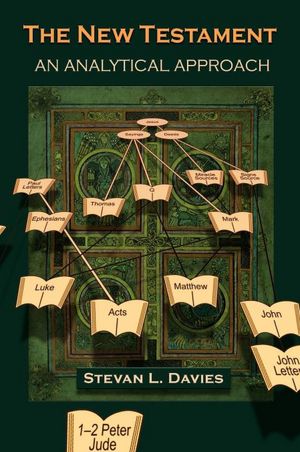
This introductory text takes a secular approach to New Testament study. The book begins with a discussion of the differences between analytical and traditional church approaches. It maintains that students can learn to work with both and not feel that they must sacrifice one for the other. Davies does not presuppose students knowledge of biblical text or points of view, and he carefully explains topics such as how New Testament authors selected, edited and embellished sources to address concerns raised by their various communities. His clear and concise style enables students time to read both the book and the biblical text in depth. New to this edition: revised chapter on Paul placed ahead of the Gospels; new introduction to the Gospel of Thomas; new comprehension questions, and updated analytical exercises; comprehensive subject index.
A reviewer who teaches New Testament courses to university undergraduates and who read Davies’ earlier book, New Testament Fundamentals, calls it “the best book for New Testament and probably the best book for ANY course, that I have ever used”. I have to confess that if I had studied the The New Testament, An Analytical Approach, in seminary using Davies’ book, I would have acquired a knowledge of the subject even superior to that which I had, and I believe my seminary courses were very good, indeed.
Davies’ book is not so much one for an individual seeking a new book on the New Testament as it a guide for a very comprehensive and analytical study, with a copy of the New Testament always at hand. It is especially suitable as a guide for group study. The “analytical” nature is illustrated on the very first page where, under the word “Introduction” is a brief paragraph titled
Objectives
. Establish a basic overview of the components of the Bible
. Learn how scholars read the NT analytically. i.e. to answer the question “what
happened?” before considering the question, “Is it true?”
. Become acquainted with the tools and resources available for analytical study.
Writers who offer such clear guidance for their readers rank very high in my appreciation. Davies does this all through his book. He states that he writes for both a secular and religious audience. Also very helpful is that he writes with the assumption that his readers are not already knowledgeable in either the Bible or Christian history. As a life-long Christian I found it helpful to be reminded of things I had once known but had mostly forgotten.
His approach is stated in his introduction, where he writes, “The New Testament maybe understood at the same time from a church perspective and an analytical perspective”. . . . .”This textbook is not intended to defend an analytical perspective against a church perspective; it is intended to make the analytical perspective clear so it will be available to any person wishing to see it.”
On the following page he writes; “Analytical study of the New Testament is not the study of Jesus. It is, rather, the study of diverse teachings about Jesus.” This is followed by; “Analytical study does not prove or attempt to prove that the New Testament is divinely inspired. Neither does it prove or attempt to prove that the New Testament is not inspired. It is neutral.” Analytical study is, in great part, the process through which the New Testament came into being.”
For one who believes in the divine inspiration of the New Testament, Davies’ book helps us understand how that divine inspiration worked its way to finally appearing as written documents.
“”The Lord works in mysterious ways” and only the very arrogant will declare they know how God arranges revelation before they have studied it in all of its diversity. If the New Testament is divinely inspired, as we study it we learn about divine inspiration. If it is not divinely inspired, the New Testament we study still is the most important collection of documents in the history of the Western world.”
I could easily go on with quotes that I found deeply meaningful and even profound, but it is better that I simply state that I found this book such a clear presentation of some of the most basic issues now confronting the Christian faith that I encourage both those who consider themselves Christians and those of other faiths or who label themselves atheists, but are curious about the origins and the role of Christianity in the contemporary world.
One of the things I found so very interesting, though I suspect it would have made me uncomfortable in my very early years, was how much acrimony there appeared to be within the early churches which received letters from Paul. And Paul and other church leaders could be quite strong in their attacks on those with other ideas about some theological issue, sounding quite contrary to the spirit expressed in Paul’s treatise on “Love” in his letter to those at Corinth.
Davies has written books on the Gospel of Thomas and includes a section in the Appendix on the Gospel of Thomas, which is a document gaining an increasing interest in particular among those with a scholarly interest in Christian origins. It provides us a wider understanding of what a diverse, rather than unified movement was present in first three centuries of the Christian faith.
As stated earlier, Davies’ book should not be approached as one to be quickly read through, but as an ongoing and comprehensive guide read with continual references to the wealth of selections from the New Testament, with the end goal of a thorough and comprehensive understanding of what he rightly calls “the most important collection of documents in the Western World”.