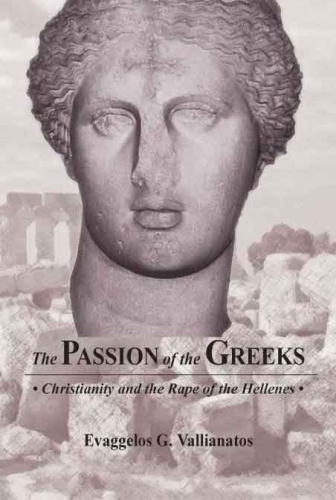
Vallianatos’ book addresses a crime of the past that still affects us today, and whose rectification could facilitate a more humanistic future. He reveals the censored history of the conflict between Christianity and ancient Greek culture (“Jerusalem versus Athens”) in late antiquity.Though the “conversion” of the Greeks is traditionally presented as peaceful and pious, in fact, it was a bloody and brutal conquest, where Christian monks (and even Goths) were funded by Christian Roman emperors in an attempt at forced assimilation of the Greeks into a Judaeacized Latin Empire.
Vallianatos contrasts Hellenic values with Christian values, art and government. The Greeks valued democracy, freedom, piety, and the struggle for the good, the brave, and the beautiful. In sum, they had an appreciation of and enthusiasm for life. Zeus is a good god. The Christians valued austerity, harshness, conformity, dogma, despotism, sin and hell, the exploitation of guilt and fear, intolerance, a hatred for Greek literature, philosophy, and art; a cult of death, with life only “after death.” The Jewish/Christian god is a jealous god.
Vallianatos describes how the Greeks resisted Christianity for centuries. In the war against the Greeks, the Christians branded the Greeks as “pagans” and, in the guise of “fighting paganism,” defaced or destroyed their temples, academies, sculptures and art, in sum, their culture. Vallianatos makes a convincing case that the “conversion” of the Greeks was, in fact, a conquest and despoliation no less than the later Turkish conquest.
A lively, informative, passionate book covering long sweeps of crucial history.
Evaggelos G. Vallianatos
Clock & Rose Press, Cape Cod. 2006
“Passion” is not only part of the content of this book, but is also its tone throughout. It is made clear from the beginning that Vallianatos cares very deeply about his message. His first name, Evaggelos seems appropriate, as he conveys his story with an “evangelistic” fervor. As we learn his personal and family history, his passion becomes understandable.
Evaggelos was born and raised on the island of Kephalonia, the largest of the group of western Greek islands between Greece and Italy. Born and raised by a devout Christian mother, in a culture with a long and pervasive Christian history, he had some experiences that began to bring disturbing questions to his mind. A brief moment with a priest who was likely a pedophile disgusted him and made him continue his wish to probe the elements still present from his ancient Greek past.
In his teens he learned of the role Christianity had played in the attempted destruction of the truly remarkable culture that had once been Greece. He became very angry and began his life-long effort to correct what he believed was one of history’s greatest wrongs.
Evaggelos came to the United States in the 1961’s and has a Ph.D. in history from the University of Wisconsin. He has published books on agrarian issues, which might seem strange, but will appear natural further in the review.
Few Christians learned in Sunday school about the efforts made by our early church fathers to suppress the views and actions of those they considered heretical or pagan. We didn’t even learn about the conflict between Peter and Paul and the division into separate and competing groups, with vitriolic words used as weapons to denigrate the opponents. And we most certainly did not learn of the vigorous and even vicious efforts to suppress and eradicate all evidences of views held by opposing groups.
It is incredible, when one has grown up believing that the central message of Jesus was about love, to learn that vicious cruelty and barbarism were commonly a part of the early efforts of the church to grow in power and wealth. What Sunday school class material has ever taught that Emperor Constantine embraced the young Christian faith both for political reasons and from his guilt of having just had his wife and son murdered, rather than from having a vision from God.
Along with his knowledge of such as the above, Vallianatos learned of the campaign by the Christians to tear down and destroy all evidences of the rich pantheon of the gods of the Greeks. Temples, statues, libraries, all remnants of the “idolatry” of the heathen pagans were targets for destruction.
While we have known that the Olympic Games began in Greece, few of us have known much of the culture that produced them. Beginning a thousand or more years BCE, the culture developed that continues today to provide many fundamental elements of our own society, including our government, law and politics, our philosophy and science, art and architecture, and our agriculture and environment.
The polytheistic Greek religion was centered on life in the here and now, rather than a hereafter. It celebrated life as found in the human body and in the myriad plants and animals among which we live. It saw our present world as good. Nature is a friend and a blessing to mankind given us by the gods.
Vallianatos contrasts this with the Christian focus on death and the hereafter, with much of the present world seen as either an enemy or a curse to be overcome or endured until freed by death. That such a negative and death focused religion would ever supplant a glorious life affirming faith infuriates the author and he is committed to making, first of all his own Greek people, but also the whole world aware of what a terrible thing happened. He wants a restoration of his ancient Greek faith to take hold and flourish. He believes such a restoration would not only bring Greece again to a place of deserved respect in the modern world, but would go a long way toward our finding solutions to some of the difficult problems of our world.
“A god to a Greek is not what the Christians (or other monotheists) understand their god to be. The Greek god was sometimes an immortal being of pure goodness, intelligence, beauty and power but, more often, the Greek god was a mixture of human and divine elements, a humanlike god or godlike human with immortality, goodness, power, beauty and intelligence to spare – the very ideal of Greek philosophy and culture, kalon k’adathion, the beautiful and the good.”
Vallianatos contrasts this with what he describes the Roman Emperor Julian said about the Christians, whom he contemptuously called Gallilaians. These people, he said, manufacture a religion that, first, has nothing about it that is divine, and, second, is a criminal conspiracy. But they have made it attractive to that part of the human soul that appreciates childish and foolish things and loves fables.”
He uses Thomas Jefferson, calling him a phillelene who defended reason and found a place for Greek philosophy that separated religion and the state in America. He quotes him: “Millions of innocent men, women, and children, since the introduction of Christianity have been burnt, tortured, fined, imprisoned.” He then cites D.H. Lawrence, who described Christianity as a religion of death.
“No one can say something like that about Greek religion – a religion without a holy book, a priestly class, or dogma. The Greeks did not go around the world making others Greek by the sword. They practiced what they believed. Their gods would not have put up with such a hideous concept.”
Evaggelos, to his credit, sees the early Hellenes as playing an important role in their conquest by the Romans. They had gathered together in hundreds of city states, which have been called “Polis”. These were truly remarkable examples of very highly civilized communities, most beginning as small monarchies, but in time developing into experimental democracies with governing bodies that meted out justice, oversaw issues of property, but also promoted festivals of the arts and physical excellence. But in their concern for freedom and enlightened self rule they were resistant to uniting into a powerful nation, instead engaging in quarrels and wars among themselves. The result was in their being conquered piecemeal by the powerful and united Roman Empire.
But it was not Rome alone that led to their desecration. Rome adopted much of the Greek culture and greatly valued what they had acquired in their conquests. It was instead when, under Emperor Constantine, that Rome began the mergence with the Christian religion that Christian Rome used its immense economic, political, legal and military power to suppress and then eradicate the Hellenic religion and all of its ramifications.
I can still recall the way the word “idols” was spoken in my early Christian education. It was said in a way that conveyed the dirty, sickly, awfulness of some slimy thing. As I see the few damaged and broken remnants of Greek statuary today, I marvel at their deeply appreciative value of physical, including human, beauty.
They were the original “Greene People”, One Greek gift to us that is just now beginning to be appreciated is that of their great wisdom regarding all that is a part of the living world, including the soil in its many conditions, the rain, the wind, the seasons, the sunshine and how it all must be both understood and appreciated for them to gain a livelihood from the soil year after year and generation after generation. The location, terrain, and climate of the Greeks resulted in their being able to bring a fairly good level of crops, but not without wise and persistent labor. That level of understanding had a reverential quality that made it natural that they would worship and give offerings to the many gods involved.
In his last chapter, Vallianatos names the primary Greeks whom he feels we would benefit from reading. His list includes the better known names such as Homeros, Demosthenes, Sophokles, (he uses “k” rather than the anglicized “c”), Aristoteles, but also includes others known to few modern westerners. He says “This is because these Hellenes would provide a fresh non-Christian position from which to stand and view the world. He works for “another global renaissance, another translation movement of the Greek classics without end.”
In the new Greece, that renaissance would include a guarantee of freedom of religion, outlawing proselytizing by any monotheistic sect in Greece. It would drop the Christian clergy from government support, appropriate monasteries and churches, using that wealth for the reconstruction of ancient temples, festivals and other Hellenic culture. It would, in short, be a complete restoration of ancient Hellenism within modern Greece.
In an email from the author, since my reading the book, he informs me that in the last thirty years, new groups of polytheistic Greeks have formed to worship their ancient pantheon and to study and be inspired by their history. They meet opposition from both the government and from the church. Vallianatos estimates there may be more than 50,000 of today’s Greeks following the gods. One group known by the name “Ethnikoi”, meaning Nationals or Hellenes have a branch in New York.